
This essay is about the political football that plug-in hybrid electric vehicles (PHEVs) have become. This is NOT a criticism of that class of vehicles; PHEVs have an important role to play. There is a best-car choice for every owner, and in my case it has often included a plug-in; I have owned one since 2012. However, plug-ins are not right for everyone. Read on!
Toyota has long argued that PHEVs are better for the planet than BEVs and should therefore count as BEVs in the (discontinued by Trump) calculation of fleet fuel economy standards (see A year ago, major media outlets were blaming consumers for a slump in US EV sales; did that actually happen?). Their argument is as follows:
- – PHEVs use smaller batteries than EVs. For example, a Tesla model Y (BEV) has a battery about four times the capacity of a Toyota RAV4 PHEV. Toyota’s argument assumes a five-fold BEV/PHEV battery size ratio, a mild exaggeration.
- – If lithium availability is the only factor holding back automotive electrification (assumption 1) and lithium supplies are limiting (assumption 2), we should drop the BEVs and use the lithium to build five times as many PHEVs, accelerating the transition to high efficiency vehicles (assumption 3).
Assumption 1 is not true; many other factors are holding back EV adoption, of which the source of lithium is a minimal buyer’s concern (it has a small influence on sticker price):
- – “Gas is so cheap, why should I bother?”
- – There is a serious shortage of convenient daily charging opportunities for renters, frequent relocators, homes with no off-street parking.
- – “I’ve heard there aren’t many fast chargers” (see link).
- – There is no EV dealer for my brand in our area.
- – “They don’t make an acceptable EV in the vehicle class that I want”.
- – So many new hostile government policies (extra taxes, rules against EV dealers in some states, etc.)!
- – “I can’t be bothered to tackle charging”.
- – “I enjoy it when my car makes intimidating noises”
- – There are few options for buying used EVs.
- – My dealer says I won’t like an EV; too many hassles (however vaguely defined).
(EV advocates might wish to treat this list as a to-do list of challenges).
Assumption 2 (lithium is limiting) is not true. Lithium is found in almost every country; the US has ample supplies. In the earth’s crust lithium availability is on par with lead (https://en.wikipedia.org/wiki/Abundance_of_elements_in_Earth%27s_crust). Lead is an element of great interest to the industrial world, but not subject to any particular concerns about scarcity.
The issue is that the Chinese have an effective monopoly on lithium smelting. Lithium is mined in the US, but raw US lithium ore is then shipped to China for smelting and refining. When it comes back to the US, it is pricier than buying refined Chinese lithium so there isn’t much of a market for it here. This is causing Western manufacturers to search for subsidies to promote the development of new lithium mining and smelting infrastructure. I expect that new lithium infrastructure will modestly raise battery prices in the short run. However, there is no doubt that it can be done and needs to be done for the security of all concerned.
The third assumption (PHEVs are high efficiency vehicles) has only recently received serious consideration: how much pollution is saved by driving PHEVs versus EVs? This can be broken down into environmental costs of:
- – manufacturing PHEVs versus EVs
- – operating PHEVs versus EVS, and
- – the driving habits of PHEV versus EV owners.
The first two of these three bullets (manufacturing and operating costs) are often shown on the same graph because they are hard to separate and they offset each other to some degree. That is, EVs produce major pollutants in manufacture; gas cars produce their major pollutants when driven. I got this following graph from Trump’s EPA (epa.gov/greenvehicles/electric-vehicle-myths, accessed 5 Feb 2026):
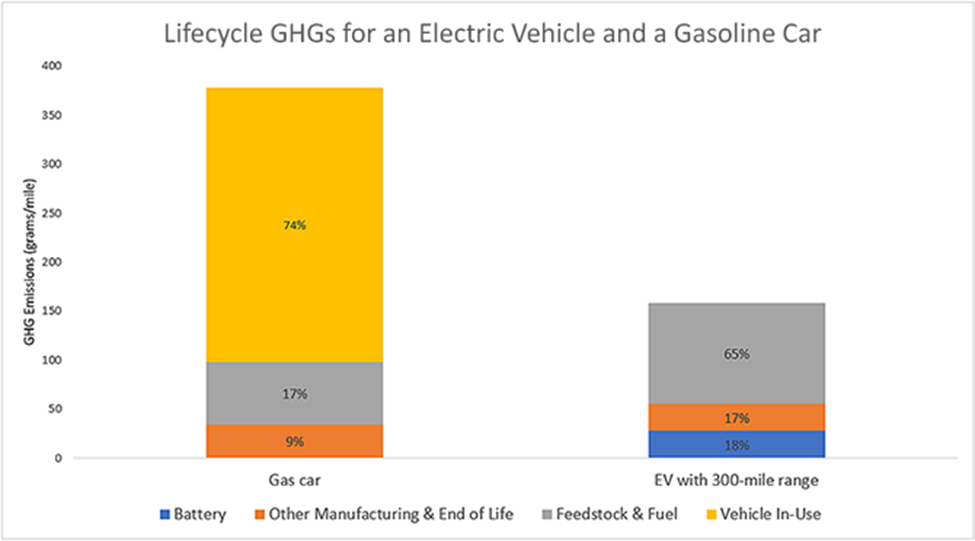
GHG is short for greenhouse gases and includes carbon dioxide, methane, fugitive refrigerants, and so forth. The blue sub-bar represents the GHG emissions of battery manufacture and will shrink as recycled lithium becomes available when EVs are retired; regardless, it is a significant manufacturing cost for only EVs. The dark orange sub-bars are other manufacturing GHG emissions, roughly equivalent between the two car types (the percentages shown are in relation to their respective total bar heights, not relevant for comparing colored bar heights between car types). The gray sub-bars are electricity generating emissions (electric power plant emissions for EVs during manufacture or use; electricity during gas car manufacture or liquid fuel refining). Note that the gray sub-bars are therefore a bit of a hybrid: some fueling costs for gas cars appear in the lefthand gray bar, but all of the fueling costs for EVs appear in the right-hand gray bar. Finally, the tailpipe emissions during vehicle operations are shown in the yellow sub-bar. EVs produce none.
What about PHEVs? They are somewhere in between, dependent on how much they are driven on gas versus electricity. I have not seen a recent credible analysis for PHEV emissions and that brings up the “hidden weakness” in the title of this essay. It turns out that the assumptions that the various regulatory bodies have been making about the driving habits of PHEV owners are not well grounded in human nature. For example, in Europe regulators were assuming that 84% of PHEV drivers were driving primarily on electricity. Recent measurements are that the true value in Europe is around 27% (www.fastcompany.com/91476440/gm-ceo-mary-barra-says-people-arent-plugging-in-their-plug-in-hybrids-that-defeats-their-whole-purpose). This means that previous estimates of the pollution emitted by European PHEVs are off by a factor of 3.5-fold.
Statistics for the US are less well documented (though as the link name suggests, General Motors’ CEO Mary Barra has admitted in a recent investor call that people are not plugging-in PHEVs as much as GM had been assuming). A non-governmental non-commercial organization by the name of International Council on Clean Transportation (funded with charitable grants from private foundations) found that 26 to 56% of American PHEV drivers use electricity less than the EPA assumption, and therefore fuel consumption in PHEVs is 42-67% higher than the EPA rating that was formerly displayed on PHEVs’ window sticker (Trump ended this practice).
There are two components to the PHEV “shortfall”: the ratio of long to short trips (electricity is rarely used to propel long-trips in PHEVs) and the diligence with which PHEV-owners plug them in when the opportunity presents itself (typically every night when parked at home). Understandably, both components may differ between regions and continents. But plugging PHEVs in is the easiest task that is needed; when they get home most owners reflexively reach for the plug in the garage and insert. Failure to do so defeats the GHG savings the PHEVs are capable of.
Furthermore, schlepping around a propulsion system while you are not using it has a cost to the owners’ pocketbooks both on purchase and with use; PHEVs have lower fuel economy than plain gas cars when running on gas alone and lower electric mileage than EVs of similar battery weight and class when running on battery. Maintaining two independent propulsion systems also significantly raises the maintenance cost of PHEV ownership relative to either gas cars or EVs.
It would be easy to sneer at the failure of PHEV drivers for failing to plug in, but we need to know more. What is stopping them from plugging in? Are some PHEV drivers unable to access a plug where they park? Are there policy changes that might help them out (e.g., require apartment complexes to provide access to EV chargers for their residents)?
Why does one buy a PHEV if one doesn’t plug in? Some of the answers are troubling; I’ve heard from several people who were diverted from buying their preferred EV by a confident and assertive car salesperson. Some people no doubt feel more “respectable” by driving a car assumed to be greener. Some people may be planning for the future, and will plug it in when they move to a new house, etc. Some car buyers will spend a lot for the option value of a particular feature. They feel good about keeping their options open. We’ve all seen people who buy a giant pickup truck with the expectation that they need such a behemoth to tow their speedboat to the lake on weekends. In the first year, they do indeed tow the boat many weekends. In the second year, not so much. After the babies come along, almost never. Eventually they just use the 14-mpg truck to commute to work. Option value has a cost.
EV promoters have the challenge of learning the tricks that car salespersons master; what motivates or demotivates a prospective car buyer? It is not all about saving money, effort, or the planet. Motivation is a mystery that rewards careful consideration.1
1. Once upon a time I taught a psychology course entitled Motivation and Emotion at a flagship state university. At the time, psychologists knew quite a bit less than did advertisers, artists, musicians, and con men. Maybe that hasn’t changed.

Good choice of topic, and well-written. I wouldn’t have had much comment anyway, but I thought I had a day or two to respond. No problem. You covered the issue of PHEVs very thoroughly, and I learned a lot. Every time I see a graph like your Life Cycle Emissions comparison, I keep wishing there was a third bar on the graph that basically eliminates the gray portion for BEVs when they are fed by a solar array on the roof. That makes a BEV option look pretty dramatically better than a gas car. I’d like to see that third bar because it might make more people (who could afford it) consider that option if they’re serious about GHG emissions.
Because you’re so good at explaining complex issues related to EVs, here’s a topic for you to consider tackling, Gordon: Both Deb and I go crazy when we talk to people who have bought an EV but disabled any regenerative braking. I know you’ve mentioned that you don’t feel it’s as egregious as we tend to think, but I’ve never seen a good analysis of this aspect. People probably disable it because it’s not what they’re used to. We have one daughter who uses full regen and loves one-pedal driving, and one daughter that has disabled regen. Just a thought.
Thanks again for your thorough research and clear presentation (with a few touches of Gordon humor)!