At a recent county commissioners’ meeting in Montezuma County, Colorado (Cortez), the issuance of a permit for a solar farm was considered. Ordinarily, the heavily agricultural county would be strongly receptive to allowing a farmer to do whatever they chose with their land. However in this case, agricultural interests were openly hostile to free-enterprise, insisting that it was immoral for agricultural land to be used for non-food products. This will come as a surprise to farmers in Iowa, for whom support for ethanol subsidies is a litmus test for any Presidential aspirant. In the case of the solar farm in Montezuma County, the prevailing sentiment was against the proposed solar farm and the commissioners denied it. I do not wish to suggest that this position – that farmland for fuel is immoral – is held by farmers alone; I have heard similar sentiments from across the political spectrum.
Biofuels came to the fore in the early 2000s, when solar cells (PV) were not yet cost-effective and the world was, once again, struggling with the conflicts generated by the patchiness of global oil deposits (recall the joke of that time: “what’s our oil doing under their sand?”). In the decades since, the acreage devoted to biofuels has only increased and subsidies for planting biofuel crops have grown more entrenched. A recent study by a think tank (Our World in Data.org) recently evaluated biofuel farming in light of how the world has changed since 2000. Their dispassionate report, authored by Ritchie and Rosada (R&R 2026), is well worth reading (link: ourworldindata.org/biofuel-land-solar-electric-vehicles).
R&R find that 99% of liquid biofuels are currently used for land transport (gasoline and diesel); the remainder are used mostly for aviation fuel. In order of descending importance, the biofuel producing areas of the world are: 1) Midwestern US corn belt, 2) Brazil’s sugarcane belt, 3) Europe’s corn belt, and 4) Indonesia’s oil palm plantations. Collectively, these produce the fuels for 3-4% of the world’s land transportation. When the proportion of the farmland that is used for land transport fuel crops is apportioned among the biofuel farms, the global land area involved in more than the total combined surface areas of the US states of Florida and Georgia.
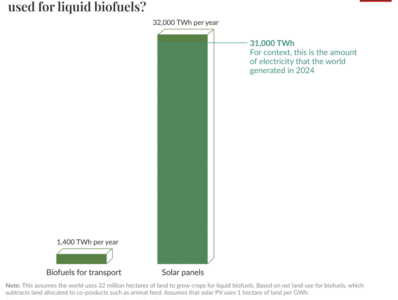
For comparison, R&R ask how much electric fuel could be generated by PV panels on the same farmland. I was flabbergasted to learn that such a land base could supplant current electrical generation on Earth, assuming that the juice could be stored in a way that would match the time of supply to time of demand. The authors did not suggest that this be done, but they did urge readers to consider the magnitude of that quantity. Their graphic is duplicated below.

Understandably, R&R felt the need to explain how this could possibly be. They start by noting the low efficiency of crop plants (~1%) in converting sunlight to fuel. Solar panels do much better (15-25%) and the latest (2026) perovskite solar panels are targeting 30% efficiency. Also, the use of liquid fuels in internal combustion engines (ICEs) is inherently inefficient, roughly 1/3 that of comparable EVs. More liquid fuels are needed to fuel ICEs than electricity would be needed for EVs.
Which brings up the key observation: biofuels are used for powering ICEs; solar farms are used for powering EVs and other electric power uses. Thus, biofuel use for land transportation will diminish as the electrification of transportation advances and the freed-up farmland – if the world so chooses – is replaced by solar farms. How much land would it take for solar farms to make up for the loss of liquid fuels by abandoning biofuel crops?
As R&R put it, “The world could meet 3% or 4% of transport demand with biofuels. Or it could meet all road transport demand on just one-quarter of that land.” R&R do not propose that this be done but argue that it gives policy makers a useful perspective on the land cost of biofuels. They strongly encourage thinking about what is the highest and best purpose for the land presently used for biofuels. Some land could be used for food, some for liquid fuels, and some might best be returned to natural environments for the ecological services such land could provide. Perhaps the farmers in Montezuma County can talk to their compatriots in Iowa and find a better use for the corn cropland there. At a minimum, taxpayers should insist on an end to wasteful and counterproductive ethanol subsidies.

Amazing, Gordon. Truly, Congress and ethanol corn farmers should have to face these statistics and come to grips with the insanity of the corner that we’ve backed ourselves into. I don’t know the extent of your blog readership (may be more than I think), but I wish your articles would be published where they could get more exposure…. especially articles like this one that would be of interest to a wider audience than just the EV crowd.