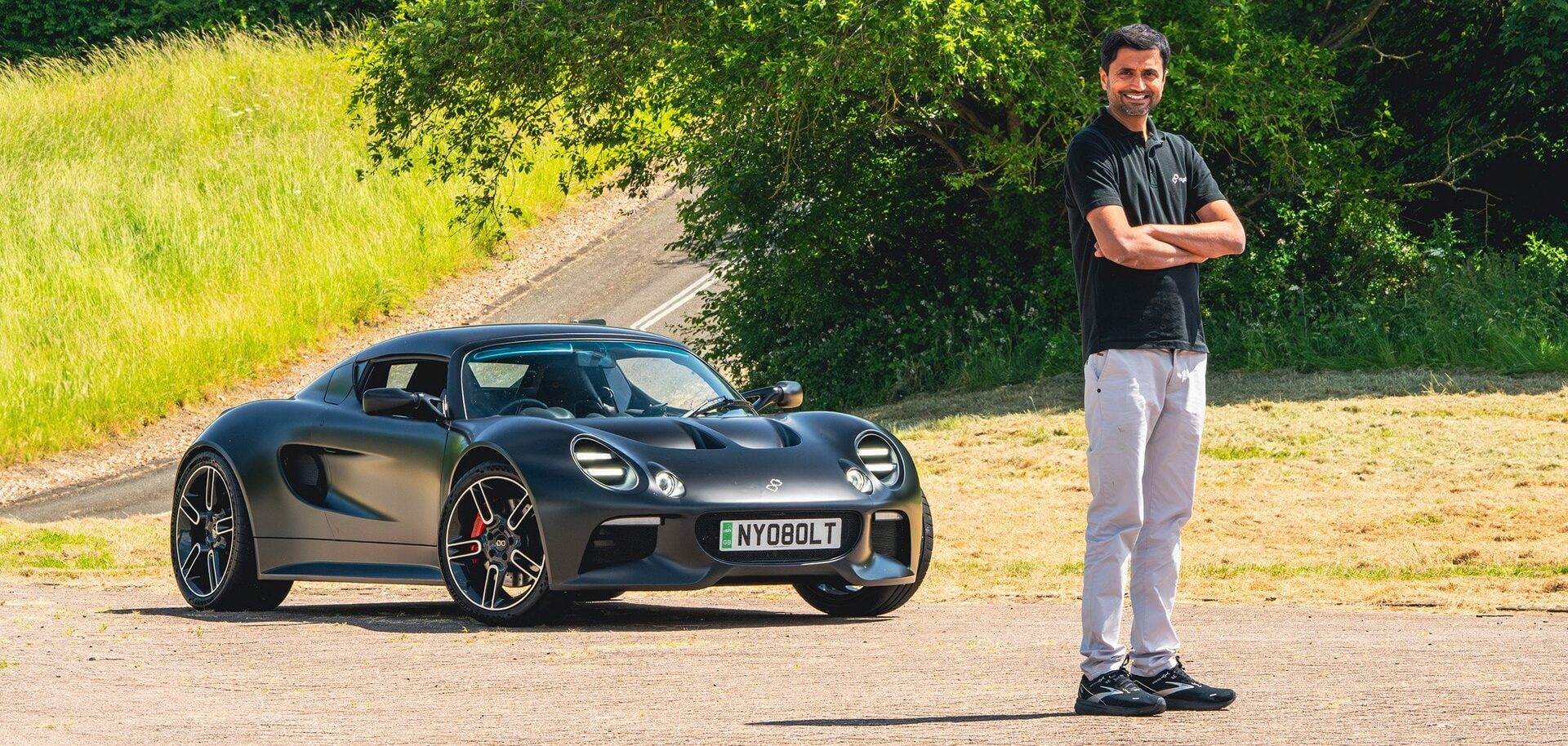
The British firm Nyobolt (relying on Cambridge University battery scientist Clare Grey) recently demonstrated a mockup vehicle (see photo; car made by a different company) that was able to charge from 10% to 80% charge state in 4 minutes, 37 sec. A constant current of 500 A (800 V, supplied by a 350-kw fast charger) for 4 minutes provided the bulk of the charge (yielding 120 miles of the vehicle’s 155 miles range when charged to 100%; a vehicle with roughly the efficiency of a Model 3). A third party verified that these particular cells retain 80% of their original capacity after 4000 complete fast-charge/discharge (0 to 100%) cycles (www.autoevolution.com/news/nyobolt-s-cells-are-closer-to-production-than-we-could-imagine-238458.html).
In the illustrated mockup vehicle (no production of the vehicle is planned), this number of charge cycles would suffice to propel the car for > 600,000 miles. Nyobolt’s primary chemical claim to fame is use of niobium tungsten oxide anodes, which have been tested to provide > 25,000 charge cycles, equivalent to roughly 4 million miles in the mockup vehicle, but there is no claim by Nyobolt that they intend to manufacture EV batteries with a niobium anode (such batteries are too expensive, and niobium is mined in insufficient quantities for such a product). Most industry insiders do not believe niobium anodes are scalable for EV mass adoption (So, how soon might we see these fast-charging non-niobium EV batteries on the road? Several unnamed automotive manufacturers are testing Nyobolt’s prototype batteries (Volvo/Polestar was named). Several caveats need to be kept in mind. The mockup EV is small and light (photo); it has only a 35-kwh battery, which is only modestly larger than the one in my RAV4 plugin hybrid (PHEV). Scaling up the battery size (with no concomitant upsizing of fast chargers) will likely extend the charging time appreciably. Faster chargers are not yet readily available. Prices of the batteries have not been made public, but we all know that things change between the pre-production hype and the roadway. And promised timing of delivery tends to be aspirational. If the batteries, which will be made by Nyobolt, come off the production line at the end of 2026 as promised, how long might it take for manufacturers to integrate them fully into practical EVs?
Nonetheless, Nyobolt is closer to production than any of their competitors (the Israeli StoreDot batteries have also received considerable media attention, but StoreDot is further behind in testing, and I would not want to be building a big industrial complex in Tel Aviv at the moment). StoreDot is hyping a similar 100-miles-of-added-range in 5 minutes Li-ion battery which has been tested for 1000 charge cycles. StoreDot claims, utterly with no self-interest – hah! – that solid state Li-ion batteries (which they are not making) won’t be in production until at least 2032. QuantumScape, a leading solid-state battery developer, would no doubt beg to differ. I recall VW saying they were putting QuantumScape solid-state batteries into their 2023 EV lineup: didn’t happen.
That said, steady progress is being made in EV batteries, EV-charging infrastructure, and vehicle configurations. With a larger battery, Colorado-scale road trips with a pure BEV are barely inconvenienced by charging rate. For home renters or owners of charger-free condos, New Mexico residents, or southern Utah visitors, charger availability is apt to be a larger issue than charging speed, but it is heart-warming to see that charging speed is well on its way to becoming an issue of the past.
(Kudos to Chris Calwell for bringing this battery development to my attention.)
